

Life is full of small decisions: Should I pick up that sock on the floor? Should I do the dishes before bed? What about fixing the leaky faucet in the bathroom?
Negentropy, the opposite of entropy, can help improve daily decision-making and social systems by minimizing energy loss. By identifying where energy is wasted and implementing targeted solutions, individuals can enhance efficiency and effectiveness in their personal and professional lives, ultimately leading to greater accomplishments.
In This Article
- What is the problem with energy loss in daily life?
- How does negentropy work in social systems?
- What methods can reverse energy loss effectively?
- How can negentropy be practically applied in daily routines?
- What are the risks and limits of focusing on negentropy?
Life is full of small decisions: Should I pick up that sock on the floor? Should I do the dishes before bed? What about fixing the leaky faucet in the bathroom?
Leaving a sock on the ground is a manifestation of a concept from physics you may have heard of: entropy. Entropy is a measure of how much energy is lost in a system. If a system loses too much energy, it will disintegrate into chaos.
It takes only a little bit of energy to pick up one sock. But if you don’t take care of your yard, let pipes stay clogged and never fix electrical problems, it all adds up to a chaotic home that would take a lot of energy to fix. And that chaos will leach away your time and ability to accomplish other things.

The good news is that entropy has an opposite – negentropy. As a researcher who studies social systems, I have found that thinking in terms of negentropy and energy can help you fight against entropy and chaos in daily life.
Minimize energy loss, maximize progress
In both physics and social systems, energy can be defined as the capacity or ability to do work. For more than two decades, I have studied social systems in schools, community dialogues, universities, corporations and nonprofit organizations. During that time I’ve observed that energy losses are a constant – for example, meetings of four people to plan meetings for seven people, or everyone’s worst nightmare, meetings that could have been accomplished through email. These small frustrations can even build to a point where good employees start quitting.
After thinking about energy for so long, I began to wonder – as others have – whether applying physics concepts to social systems could help them run better.
Over the past four years, my colleagues and I developed a theory of negentropy and, using interviews and case studies, have studied how energy is lost or gained in many types of systems – including in higher education, leadership for online education, workplace organizations and online learning settings.
Our work suggests that when people keep the idea of negentropy in mind and take actions that limit or reverse energy loss, social systems are more efficient and effective. This might even make it easier for people to achieve larger goals. In other words, yes, you should pick up that sock, and yes, you should improve your meetings, and doing so may allow you to see other ways to avoid future energy losses.
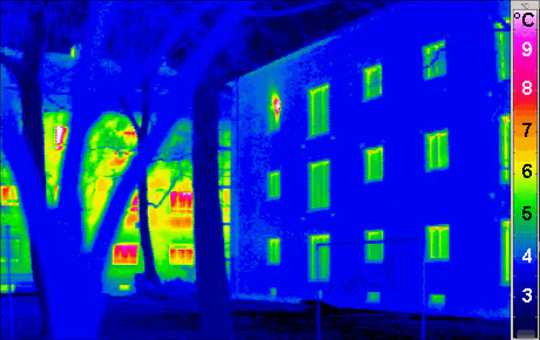 Energy loss in your daily life is just like heat leaking out of a badly sealed house. Passivhaus Institut, CC BY-SA
5 steps for negentropic success
From my colleagues’ and my research into negentropy, we have come up with five steps to reverse energy loss in in daily life.
1: Find the entropy.
Identify places where energy is lost in the social systems in your daily life. It’s helpful to think of it like a thermal map of the outside of your house that highlights where heat – or energy – is lost. A badly sealed window leaks heat energy. A poorly organized kitchen makes things hard to find. A badly designed new employee onboarding system can lead to serious legal problems later.
2: Prioritize the losses.
Identify the largest or most annoying losses and those that draw your attention most often. For example, perhaps that leaky kitchen faucet drives you crazy. Fixing it might make room in your mind to consider other improvements to your kitchen that would make it more functional.
3: Come up with a plan.
Identify actions that will reverse the energy losses you noted and plan ways to address the highest priorities first. You could start by fixing the leaky faucet or picking up your socks; if pre-pre-planning meetings are causing your organization a lot of trouble, analyze the problem and figure out how to fix it.
4: Try it out and pay attention.
Put the ideas into action, but stay focused on energy gains and losses. As you try to implement negentropic ideas, keep track of what works, how much effort it took and ideas you come up with for future negentropic actions.
5: Go beyond fixing and maintenance.
As you work to reverse energy losses, you may find that at times you are actually maintaining a social system that isn’t beneficial no matter how smoothly it works. Spending time improving an orientation to introduce new workers to a company culture may not be very useful if the culture itself needs to change. The best way to apply the idea of negentropy to social systems is to not only improve the small processes, but also look at the big picture and see if the status quo itself promotes energy loss.
Seeing things through a negentropic lens won’t solve a bad relationship or help you love a job you hate – those are complicated issues. However, if you begin to notice where energy is lost in your life, it will be easier to prioritize and act in ways that can improve the social systems around you.
About The Author
Alison Carr-Chellman,, Dean, School of Education and Health Sciences, University of Dayton
This article is republished from The Conversation under a Creative Commons license. Read the original article.
Further Reading
-
Order Out of Chaos: Man's New Dialogue with Nature
This book examines how systems move between order and disorder, connecting thermodynamics concepts such as entropy to complex living and social systems. It provides a deeper scientific and philosophical background that complements the article’s discussion of applying physical principles like negentropy to everyday decision-making and organizational efficiency.
Amazon: https://www.amazon.com/exec/obidos/ASIN/1786631008/innerselfcom
-
The Power of Full Engagement: Managing Energy, Not Time, Is the Key to High Performance and Personal Renewal
This work focuses on managing personal and organizational energy rather than simply managing time, aligning closely with the idea of minimizing entropy and maximizing productive capacity. It offers practical frameworks that parallel the negentropic approach described in the article, helping readers identify and reduce energy drains in daily life.
Amazon: https://www.amazon.com/exec/obidos/ASIN/0743226755/innerselfcom
-
Thinking in Systems: A Primer
This introduction to systems thinking explores how feedback loops, structure, and energy flows shape outcomes in complex environments. The book connects strongly with the article’s framing of social systems through a physics-inspired lens, helping readers understand how small interventions can reduce disorder and improve overall system performance.
Amazon: https://www.amazon.com/exec/obidos/ASIN/1603580557/innerselfcom
Article Recap
Negentropy can enhance efficiency by identifying and reducing energy loss in daily life. Individuals should start by assessing their environments for areas of improvement and implement changes to foster better systems.
#InnerSelfcom #Negentropy #EnergyEfficiency #SocialSystems #DailyDecisions #Productivity